Like Button..!!!

Tuesday, May 17, 2011

Special of Today in Mahan's In Your Life :- Buddha

 The Life of Buddha 


Gautama Buddha, the historical Buddha, lived between 563 and 483 BC in the area known now as the Indo-Nepalese region. As a bodhisattva, he had passed through thousands of existences before coming to Earth for his ultimate transmigration.
This last lifetime he began as a son of the King of the realm Sakya,Sudhodanawho ruled at Kapilavastu, in Ancient India on the border of present-day Nepal, and was born in a village called Lumbini into the warrior tribe called the Sakyas (from where he derived the titleSakyamuni, meaning "Sage of the Sakyas").
According to ancient tradition, Queen Maya, his mother, first had a dream of a beautiful white elephant coming down into her womb, and this was interpreted as a sign that the Buddha, or a universal emperor, was about to be born. When her time came, Queen Maya went into the garden and gave painless birth to the bodhisattva. He immediately walked, spoke, and was received by Brahma.

Five days after his birth, the young prince received the name ofSiddhartha. When his parents took him to the temple, the statues of the gods prostrated themselves before him, great were the rejoicings of the people over the birth of this illustrious prince. Also at this time a devout old man named Asita came down from the Himalayas to meet the newborn prince. An ascetic of high spiritual attainments, Asita was particularly pleased to hear this happy news. Having been a tutor to the King, he visited the palace to see the royal baby. The king, who felt honoured by his unexpected visit, carried the child up to him in order to make the child pay him due reverence. To the surprise of all, the child's legs turned and rested on the matted locks of the ascetic.
Instantly, the ascetic rose from his seat and recognizing in the young child the 80 signs that are pledges to a highly religious vocation, and foreseeing with his supernormal vision the child's future greatness, saluted him with clasped hands. The Royal father did likewise. The great ascetic smiled at first and then was sad. Questioned regarding his mingled feelings, he answered that he smiled because the prince would eventually become a Buddha, an Enlightened One, and he was sad because he would not be able to benefit from the superior wisdom of the Enlightened One owing to his prior death and rebirth in a Formless Plane.

After seven days Queen Maya died, and her place as mother was taken by her sister, whose devotion and love became legendary.
When the young prince was in his twelfth year, the king called the wiseBrahmans in council. They revealed that Siddhartha would devote himself to asceticism if he cast his eyes on age, sickness, or death ~ and, if he were to meet a hermit.
Wanting his son to be a universal monarch instead, the king surrounded the palace with a triple enclosure and guard and proclaimed that the use of the words death and grief were forbidden. The most beautiful princess in the land, Yasodhara, was found for his bride, and after Siddhartha proved himself in many tournaments calling for strength and prowess, when he was 16, the two were wed.

Siddhartha was kept amused and entertained for some time by this privileged life behind the palace walls until one day his divine vocation awoke in him, and he decided to visit the nearby town. The king called for everything to be swept and decorated, and any ugly or sad sight to be removed. But these precautions were in vain for while Siddhartha was travelling through the streets, an old wrinkled man appeared before him. In astonishment the young prince learned that decrepitude is the fate of those who live life through. Still later he met an incurable invalid and then a funeral procession. Finally heaven placed in his path an ascetic, a beggar, who told Siddhartha that he had left the world to pass beyond suffering and joy, to attain peace at heart.
Confirmed in his meditation, all these experiences awakened in Siddhartha the idea of abandoning his present life and embracing asceticism. He opened his heart to his father and said, "Everything in the world is changing and transitory. Let me go off alone like the religious beggar."

Grief-stricken at the idea of losing his son, the king doubled the guard around the walls and increased the pleasures and distractions within. And at this point, Yasodhara bore him a son whom he called Rahula (meaning "chain" or "fetter"), a name that indicated Gautama's sense of dissatisfaction with his life of luxury, while the birth of his son evoked in him much tenderness. His apparent sense of dissatisfaction turned to disillusion when he saw three things from the window of his palace, each of which represented different forms human suffering: a decrepit old man, a diseased man, and a corpse.Yet even this could not stop the troubling thoughts in his heart or close his eyes to the realizations of the impermanence of all life, and of the vanity and instability of all objects of desire.

His mind made up, he awoke one night and, casting one last look at his wife and child, mounted his horse Kataka and rode off accompanied by his equerry Chandaka


At the city gates Siddhartha turned over his horse to Chandaka, then he cut off his hair, gave up his sumptuous robes, and entered a hermitage where the Brahmans accepted him as a disciple. Siddhartha had now and forever disappeared. He became the monkGautama, or as he is still called, Sakyamuni, the ascetic of the Sakyas.

For many years Gautama studied the doctrines until, having felt the need to learn more elsewhere, he traveled and fasted. His two teachers had showed him how to reach very deep states of meditation (samadhi). This did not, however, lead to a sense of true knowledge or peace, and the practice of deep meditation was abandoned in favour of a life of extreme asceticism which he shared with five companions. But again, after five or six years of self-mortification, Siddhartha felt he had failed to achieve true insight and rejected such practices as dangerous and useless.
Resolved to continue his quest, Siddharta made his way to a deer park atIsipatana, near present day Benares. Here he sat beneath a tree meditating on death and rebirth. Discovering that excessive fasts destroy strength, he learned that as he had transcended earthly life, so must he next transcend asceticism. Alone and weak, he sat beneath the sacredBodhi tree of wisdom, and swore to die before arising without the wisdom he sought.

Mara, the demon, fearful of Gautama's power, sent his three beautiful daughters to distract him. When that failed, Mara sent an army of devils to destroy him. Finally Mara attacked Gautama with a terrible weapon capable of cleaving a mountain. But all this was useless, and the motionless monk sat in meditation.
It was here that Siddharta attained a knowledge of the way things really are; it was through this knowledge that he acquired the title Buddha(meaning "awakened one"). This awakening was achieved during a night of meditation, which passed through various stages as the illumination that Gautama had sought slowly welled up in his heart. He knew the exact condition of all beings and the causes of their rebirths. He saw beings live, die and transmigrate. In meditating on human pain, he was enlightened about both its genesis and the means of destroying it.


In this first stage he saw each of his previous existences, and then understood the chain of cause and effect. In the second he surveyed the death and rebirth of all living beings and understood the law that governs the cycle of birth and death. In the third he identified the Four Noble Truths: the universality of suffering, the cause of suffering through selfish desire, the solution to suffering and the way to overcome suffering. This final point is called the Noble Eightfold Path, this being eight steps consisting of wisdom (right views, right intention) ethics (right speech, right action, right livelihood), mental discipline (right effort, right mindfulness, right concentration), which ultimately lead to liberation from the source of suffering.
When day came, Gautama had attained perfect illumination, and had become a Buddha. The rays emanating from his body shone to the boundaries of space. He stayed in meditation for seven more days, and then for four more weeks he stayed by the tree. Through his process of enlightenment he discovered that all sentient beings in this universal life possess buddhahold, and all are future potential buddhas.

From that time he had two alternate paths: he could enter Nirvanaimmediately, or else he could stay and spread enlightenment. After Brahma came in person to beg him to preach the law, Buddha yielded and stayed on the earth. For many years he traveled and taught his wisdom about the force of love and the destruction of all desire.
Although initially hesitant to share his insight on the grounds that humanity might not be ready for such a teaching, the Buddha decided to communicate his discovery to those willing to listen. His first converts were the five ascetics with whom he had lived when he himself followed the lifestyle of the ascetic. To these he preached his first sermon in the Deer Park at Benares, outlining to them the Four Noble Truths. Out of this small group the community of monks (or Sangha) grew to about 60 in size and came to include Buddha's cousin, Ananda, and his son, Rahula. Later the Buddha was persuaded by his stepmother and cousin to accept women into the sangha.
The remaining 45 years of the Buddha's life were spent journeying around the plain of the Ganges, teaching and receiving visitors.
"There are two extremes which are to be avoided: a life of pleasure ~ this is low and ignoble, unworthy and useless, and runs counter to the affairs of the spirit; and a life of fasting ~ this is sad, unworthy and useless. Perfection has kept its distance from these two extremes, and has found the middle way which leads to repose, knowledge, illumination, and Nirvana. So here is the sacred truth about pain: birth, old age, sickness, death, and separation from that which one loves, are pain. And this is the origin of pain: it is thirst for pleasure, thirst for existence, thirst for impermanence. And here is the truth about the suppression of pain: it is the extinction of that thirst by the destruction of desire.
"Charity, knowledge and virtue are possessions that cannot be lost. To do a little good is worth more than accomplishing works of a difficult nature. The perfect man is nothing unless he pours out kindness on his fellow creatures, unless he consoles the abandoned. My doctrine is a doctrine of mercy. The way of salvation is open to all. Destroy your passions as the elephant would trample down a reed hut. But I would have you know that it is a mistaken idea to believe that one can escape from one's passions by taking shelter in hermitages. The only remedy against evil is healthy reality."
And so Buddha travelled and preached. He performed many miracles, and converted his family and many followers. During his life the Buddha had taught that no one was to succeed him as leader of the Sangha. Instead, his followers were to take his teaching and rule as their sole guides. By the time he reached the age of 80, Sakyamuni began to feel old. He visited all of the monasteries he had founded and prepared to meet his end.
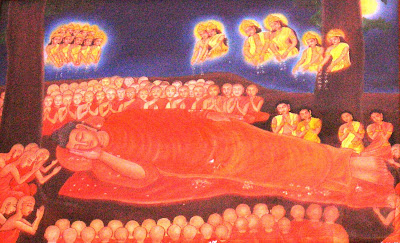
Before the Buddha's death, he became severely sick. He journeyed northwest to the banks of the river Hiranyavati, walking with his disciples, and ate the food offered by a blacksmith. His illness had progresses, and at the end, he came to the river and took a bath. Then he made a rope bed among eight sal trees, with each direction having two. He lay down on his side, right hand supporting his head, the other resting on his body. All later reclining Buddhas (called Buddha's Nirvana) are in the same posture.
The Buddha's disciples kept watch on him after they were told the Buddha was going to nirvana. At night, a scholar of Brahman went to see the Buddha, but was stopped by the Buddha's disciple Ananda. Hearing this, the Buddha called the scholar Subhadda to his bed and spoke him. Thus the scholar became the Buddha's last disciple. The final exhortation of the Buddha to his disciples was that they should not be sorry for losing their tutor. (See the last sermon of the Buddha for further elaboration.)


Growing weaker, he spoke one last time: "Do not say we have no master now. The doctrine I have preached will be your master when I have disappeared. Listen, I beg you: ALL CREATIONS ARE IMPERMANENT; work diligently for your liberation."
Having pronounced these final words, Buddha went into the jhana stages, or meditative absorptions. Going from level to level, one after the other, ever deeper and deeper, he reached ecstacy. Then he came out of the meditative absorption for the last time and passed into nirvana, leaving nothing whatever behind that can cause rebirth again in this or any other world.and finally passed into Nirvana.
After his death, Buddha's remains were cremated, as became the Buddhist tradition. The passing away, or the final nirvana, of the Buddha occurred in 483 BC on a full moon day in the month of May, known in the Indian calendar as Wesak.

Teachings

The Four Noble Truths

  1. Life means suffering
  2. The origin of suffering is attachment
  3. The cessation of suffering is attainable
  4. Noble Eightfold path is the path to cessation of suffering

Noble Eightfold Path

  1. Right View
  2. Right Intention
  3. Right Speech
  4. Right Action
  5. Right Livelihood
  6. Right Effort
  7. Right Mindfulness
  8. Right Concentration

Dependent Origination - the mind creates suffering as a natural product of a complex process
Anicca - All things that come will have an end
Dukkha - Nothing which comes to be is ultimately satisfying
Anatta - Nothing in the realm of experience can really be said to be "I" or "Mine"
Nibanna - It is possible for sentient beings to realize a dimension of awareness which is totally peaceful, and all suffering due to the mind's interaction with the conditioned world.




Monday, May 16, 2011

Mahan of the day :- Sri Sarada Devi


Her Life

Sarada Devi, (1853—1920), born Saradamani Mukhopadhyaya, was the wife and spiritual counterpart of Ramakrishna Paramahamsa, a nineteenth century mystic of Bengal. Sarad Devi is also reverentially addressed as the Holy Mother. Sarada Devi played an important role in the growth of the Ramakrishna Movement.


Sarada Devi was born in Jayrambati. At the age of five she was bethrothed to Ramakrishna, whom she joined at Dakshineswar when she was in her late teens. According to her biographers, both lived lives of unbroken continence, showing the the ideals of the householder and of the monastic ways of life. After Ramakrishna's passing away, Sarada Devi stayed most of the time either at Jayrambati or at the Udbodhan office, Calcutta. Her whole life is regarded as one of service, self-sacrifice—to her husband, to her brothers and their faimiles, and to her spiritual children. The disciples of Ramakrishna regarded her as their own mother, and after their guru's passing looked to her for advice and encouragement. Although Sarada Devi led the life of a simple rustic woman, she is accorded worship—and was, even during her lifetime—considered an incarnation of the Divine Mother.


Family house

Birth and Parentage
Sarada Devi's house at Jayrambati (centre) where she lived for the majority of her lifeSaradamani Devi, was born of Brahmin parents as the eldest daughter on December 22, 1853, in the quiet village of Jayrambati. Her parents, Ramchandra Mukhopadhyaya and Syamasundari Devi, were poor but pious. Ramchandra's earned his living as a farmer and through the performance of priestly duties and was considered generous. It is reported that Ramachandra and Syamasundari had a vision foretelling the birth of a diving being as their daughter.


Marriage
In accordance with the then prevailing custom, Sarada was betrothed at the age of five to Ramakrishna, who was then twenty-three in May 1859. Ramakrishna was then practicing sever austerities at that time and his mother and brother thought that this marriage would be a good steadying effect on him. It is reported that Ramakrishna himself indicated the bride to his mother—"Vain is your search in this place and that. Go to Jayrambati, and there in the house of Ramachandra Mukhopadhyaya, you will find her who is marked out for me." After the betrothal, Sarada was left to the care of her parents and Ramakrishna returned to Dakshineswar.

Sarada next met Ramakrishna when she was fourteen years old, and she spent three months with him at Kamarpukur. She received instructions on meditation, spiritual life by Ramakrishna. At the age of eighteen, she heard rumors that Ramakrishna had become insane, but at the same time she also heard that he had become a great mystic. She decided to go to Dakshineswar and meet Ramakrishna. During the journey on foot to Dakshineswar, Sarada Devi fell gravely ill and she describes a vision in which a "woman, pitch dark in complexion" resembling Kali said that her health would improve soon and said that "she was her sister".


At Dakshineswar Kali Temple
The south side of the Nahabat (Musical tower), where Sarada Devi lived in a small room on the ground floor.
Sarada Devi's tiny room on the ground floor of the Nahabat, now a shrineAfter arriving at Dakshineswar, her worst fears and doubts were allayed, as she could see for herself that the rumor was only the "idle gossip of worldly-minded people". She looked upon Ramakrishna as a mystic with spiritual greatness. At Dakshineswar, she stayed in a tiny room in the nahabat (musical tower). Sarada Devi stayed at Dakshineswar until 1885, except for short periods when she visited her village Jayrambati.

As a priest Ramakrishna performed the ritual ceremonies—the Shodashi Puja (the adoration of womanhood)—and considered Sarada Devi as the Divine Mother. Sarada Devi was made to sit in the seat of Kali, and worshiped with flowers and incense. Ramakrishna looked on her, as on every woman, as an incarnation of his Divine Mother, Kali. Their Marriage remained always a purely spiritual partnership. The marriage was never consummated because Ramakrishna regarded Sarada as the Divine Mother in person. According to Saradananda, Ramakrishna "married in order to show the world an ideal," the ideal of a sexless marriage.

Regarding Ramakrishna's treatment of her, Sarada Devi said, "I was married to a husband who never addressed me as 'tui.'(you) Ah! How he treated me! Not even once did he tell me a harsh word or wound my feelings." Sarada Devi is considered as his first disciple.

Sarada Devi practiced spiritual disciplines according to the instructions of Ramakrishna; of these, japa and meditation formed an important part. Her life began every day at three a.m. and being a observer of purdah, she finished her ablutions in the Ganges before daybreak when people began moving about. Sarada Devi was absorbed in japa and meditation until daybreak. She never came out till about one p.m., when there would be no one round about. She lived so quietly and unobserved there that the temple manager said once, "We have heard that she lives here, but we have never seen her." It is reported that Ramakrishna foresaw that Sarada Devi was destined to continue his spiritual mission. He taught her mantras, and instructed her how to initiate people and guide them in spiritual life. During Ramakrishna's last days, during which he suffered from throat cancer, Sarada Devi played a important role in nursing him and preparing suitable food for him and his disciples. It is reported that after Ramakrishna's passing away in August 1886, when Sarada Devi tried to remove her bracelets as the customs dictated for a widow, she had a vision of Ramakrishna in which he said, "I have not passed away, I have gone from one room to another." According to her, when ever she thought of dressing like a widow, she had a vision of Ramakrishna asking her not to do so. After Ramakrishna's death, Sarada Devi continued to play an important role in the nascent religious movement.


Pilgrimage
Two weeks after Ramakrishna's passing away Sarada Devi began her pilgrimage through North India and was accompanied by a party of women disciples including Lakshmi Didi, Gopal Ma, and Ramakrishna's householder and monastic disciples. The party visited the Vishwanath Temple at Banaras, Ayodhya associated with life of Rama. Later she visited Vrindavan which is associated with Krishna . It is reported that at Vrindavan, she experienced nirvikalpa samadhi and it was here that she began her role as guru. She initiated several of the Ramakrishna's disciples including Mahendranath Gupta, Yogen with a mantra.

At Calcutta
Sarada Devi worshipping at her Udbodhan residence in Calcutta.After the pilgrimage, she stayed alone in Kamarpukur for a few months. She was encountering difficulties in meeting her ends and was lonely. In 1888, when the news reached the lay and monastic disciples of Ramakrishna that she needed their care and attention, they invited her to Calcutta and arranged for her stay. Swami Saradananda built a permanent house for Holy Mother in Calcutta. This is the Udbodhan House, named after the Bengali monthly magazine conducted by the Ramakrishna Math. It is also appropriately called Mayerbati or "Holy Mother's House", where she spent the longest period of her life outside Jayrambati. Here an increasing number of people began to flock for guidance, instructions and spiritual initiation.

After Sarada Devi's mother, Syamasundari Devi, passed away in 1906, Sarada Devi virtually became the head of her family. She took care of her brother's widowed mother Surabala, who gave birth to a daughter called Radharani, or more familiarly Radhu. Radhu grew up to be stubborn and mentally deficient and was a constant source of anxiety and trouble to Sarada Devi. Sarada Devi played the part of a mother towards Radhu and patiently put up with her.

The Holy Mother received the highest reverence from the Ramakrishna Order and its devotees. Ramakrishna had bade her continue his mission after his passing away and wanted his disciples not to make any distinction between himself and her. According to her devotees and biographers, the hospitality of the Holy Mother was unique and was characterized by motherly care and solicitude. It is reported that a few of the devotees had mystical experiences after their contact with the Holy Mother. Some dreamt of her as a goddess in human form though they had never seen her picture before. Others reportedly received their initiation from her in their dream. One such example is of Girish Chandra Ghosh, the father of the Bengali drama, who reportedly saw the Holy Mother in a dream when he was nineteen years old and received a mantra, and when he met her many years after, he found to his astonishment that it was the same person that he had seen in the dream.

At her Udbodhan residence, Sarada Devi was accompanied by other women disciples of Ramakrishna, Gopal Ma, Yogin Ma, Lakshmi Didi and Gauri Ma being the best known. People continued to visit her for spiritual instructions. According to her biographers, her innate motherliness put visitors at ease. Though she had no children of the flesh, she had many of the spirit. She regarded all her disciples as her own children.


Last Days
In January 1919, the Holy Mother went to Jayrambati and stayed there for over a year. During the last three months of her stay her health seriously declined. Her strength was greatly impaired and she was brought back to Calcutta on February 27, 1920. For the next five months she continued to suffer. Before her passing away, she gave the last advice to the grief stricken devotees, "But I tell you one thing—if you want peace of mind, do not find fault with others. Rather see your own faults. Learn to make the whole world your own. No one is a stranger my child: this whole world is your own!". This is considered as her last message to the world. She passed away at 1.30 a.m on July 20, 1920. Her body was creamated at the Belur Math.


"I tell you one thing. If you want peace of mind, do not find fault with others. Rather see your own faults. Learn to make the whole world your own. No one is a stranger, my child; the whole world is your own."
                                                         Sarada Devi


Shree Sarada Devi-image.jpg


Sunday, May 15, 2011

Mahan of the day - SREE RAGHAVENDRA

Life of Sree Raghavendra Guru

In the court of Sri Krishna Deva Raya , the Vijayanagar Emperor , patron of arts , poets and scholars was a scholar named "Krishna Bhattu". He had a son , named "Kanakachala Bhattu" , whose son was "Thimmana Bhattu".
Thimmanna Bhattu was not only famous as a scholar proficient in the Vedas and sastras but also as an accomplished player on the veena. His Wife was a pious lady named "Gopamba". The devout couple had a son and daughter. According to the popular proverb that "one eye is not an eye and one son is not a son", they desired to have another son, So, they went on a piligrimage to Tirupathi . They worshipped Sri Venkateswara with intense devotion and prayed for a son. Being gratified by the sincere devotion of the pious couple, Sri Srinivasa appeared to them in a dream and told them that he was pleased to grant them a son who would serve as a shining example of the virtues of divine knowledge devotion and detachement and would raise the world to heights of nobility. Thimmanna Bhattu and Gopamba praised the Lord for his infinite kindness and returned to their native village of Bhuvanagiri . After the laps of nine months, Gopamba gave birth to a son on an auspicious day. He was named "Venkatanatha" as he was born out of Venkateswara's grace. The child grew up into a gracefull boy , endowed with intelligence and smartness. He was put in school on attanining the age of five. A few days later, Thimmanna took ill and breathed his last.
The responsibility of educating Venkateswara felt on Gururaja, the elder son of Thimmanna. He found much difficulty in maintaining his family. At the age of eight he performed Venkatanatha's upanayanam (sacred thread cermany) with the help of donations received from rich people. Then he sent Venkatanatha to his brother-in-law, Sri Lakshminarasimhacharya for further education.
Sri Lakshminarasimhacharya felt it not only easy but a pleasure to teach his new ward as the latter was quick to learn. In a very short time, the boy acquired mastery over the Vedas, the six sastras and the eighteen paranas and became unrivelled in scholarship.
Venkatanatha was married to a young beautifull and virtuous girl named Saraswathi at the proper age. Generally education ends with marriage.But it was not so in the case of Venkatanatha. At that time , the pontific seat at Kumbakonam was adorned by Sri Sudhindra Thirtha, who was trained by the famous Sri Vijayendra Thirtha Swami. Sri Sudhindra was proficient in the traditional sixty-four arts and he taught many peoples, besides propagating the Dwaita ideals.Venkatanatha desired to go to him and receive lessons in philosophy. Accordingly taking his elder brothers permission he went to Sri Sudhindra prostrated before him and stood at a distance in great humility. The Swami asked him who he was.Venkatanatha replied that he was Venkanna , son of the Veena Scholar, Thimmanna and expressed a desire to receive instruction from the Swami in "Sri Sudha". Sri Sudhindra was pleased with him and he not only agreed to teach him but also permitted him to reside in the mutt and receive "Thirtha" and "Prasadams".
Venkanna studied the lessons on "the Sudha" with earnestness and learnt them by heart everyday. He would get difficult portions explained by his teacher. The teacher was deeply impressed by the pupils devotion and faith and began to look upon him with affection. This roused the jealousy of other pupils, who planned to bring forth the teacher's wrath on Venkatanatha.
One day the jealous classmates went to Sri Sudhindra without the knowledge of Venkanna. They said "O preceptor! The new-comer, Venkanna, is not studying his lessons well. He is always sleepy and indulging in unbecoming in actions. It is waste to feed and teach such a pupil. He is unfit to reside in the Mutt. So, we request you to drive him out". They uttered many lies to strengthen their argument. The Swami heard them and replied "Don't worry, I shall enquire about him and set him right, you had better go away". After a while, all the pupils came to learn their lessons. Sri Sudhindra commenced teaching. But having some doubt in explaining a portion. He told the pupils to come next day and said he would explain it then.
                 
Venkanna was in the habit of listening to the lessons on "Sri Sudha" with concentration, and noting the explanations in a note-book, at night, before going to sleep. As usual, he noted down correctly what he had learnt that day and went to sleep. After a short while Sri Sudhindra came to see him. Venkanna was in deep sleep.. There were some palmyrah leaves with writings on them. The teacher took them up and observed them. Venkanna was writing a regular annotation for "Sri Sudha" , entitled "Parimalam". He referred to the explanation for the statement about the meaning of which he had some doubt. Vekanna had explained it clearly and beyond any doubt. The teacher read it and his doubt was cleared fully. He felt happy to realise that vekantanatha's scholarship and ability were unrivalled. Just then Venkanna was shivering with cold as he had no blanket to cover himself with seeing this, Sri Sudhindra wrapped his own upper garment on the sleeping pupil, took the palmyrah leaves and went away.
Venkanna got up from sleep early in the morning. He was grieved at the disappearance of the manuscripts he had by his bed-side.. He was afraid of his teacher's wrath. He feared what punishment might befall him. He was at a loss to know how to convince his teacher of his innocence. Hoping for divine grace to get out of the trouble, he finished his bath and other activities, approached the Swami, prostrated himself before him and said, "O Guru! Someone covered my body with his cloth while I was asleep last night. My manuscripts are missing. I don't know who took them; I am not to blame.. Forgive me-"Sri Sudhindra replied, "Do not worry, it is time to begin the lessons, Let us go".
On seeing the other pupils the Swami said, Venkanna is not an ordinary person, He is a genius and a man of virtue. He is writing an annotation every night on what he has learnt during the day. Yesterday I had to dismiss the class as I could not find the correct explanation for a sentence. But last night Venkanna wrote the correct explanation for it in his book. You also had better listen to it." So saying he read out the explanation given by Venkanna in his book. All the peoples were astonished. Sri Sudhindra paid an encomium to the proficiency and skill of Venkanna and awarded him the title of "Parimalacharya", as he had written the commentary of "Parimala" on the teachings of "Sri Sudha". Ever since the other pupils showed Venkanna great respect and regard. The Swami's affection for him increased more than before.
After some days, Sri Sudhindra started on a pilgrimage, followed by his pupils. He visited various cities and villages and accepted the gifts and offerings given by the devotees and blessed them. In this manner, they reached Mathrai in the south. In that city was a Tamil sannyasi, who was well versed in grammer and was called a "Vaiyakarani". He was proud that no one could equal him in the knowledge of grammer. He wished to enter into a disputation on grammer with Sri Sudhindra . But the Swami said to him, "First you had better engage your self in a dispute with student, Venkatanatha . If you defeat him you can contest with me". The sanyasi agreed and commenced a disputation with Venkatanatha. On "Mahabhashya" venkatanatha was an adept in argumentation on all sastras. So he easily countered every one of the Sannyasi's arguments by his prowess and won over him finally. The Tamil sannyasi accepted defeat gracefully. Every one was struck with wonder on seeing the dexterity with which Venkatanatha had demolished. Everyone of the arguments proferred by the tamil sannyasi. Sri Sudhindra Swami was all admiration for his pupils excellence at argumentation. He at once blessed venkatanatha by conferring on him the title of "Mahabhashyacharya".

At that time , Raghunatha Rao was the ruler of Tanjore. He was highly proficient in music and literature. He could appreciate and enjoy the nuance of poetry. He sent an invitation to Sri Sudhindra to visit his city. The Swami accepted the invitation and paid a visit to Tanjore. The ruler showed the Swami great respect and requested him to spend a few days in Tanjore. The Swami agreed to do so.
Raghunatharao had a minister ,by name GovindaDikshita.The latter had a son,named YegnanarayanaDikshita,who was well-versed in the Adivaita philosophy and who had acquired much fame .He expressed to Sri Sundhindra his desire to engage in a disputation with Sudhindra and his pupil ,Venkatanatha ,on the coparative merits of Dwaita and Advaita.Sri Sudhindra agreed gladly and asked him first to contest with Venkatanatha.
Venkatanatha and Yagnarayana Dikshita made arguments and counter - arguments to prove their respective view -points.Very many distinguished scholars watched them carefully.Both interpreted "Tatvamasi" and "Aham Brahmasmi"as propounded by the sastras. Both being great scholars ,advanced arguments ina distinguished manner so as to amaze the listeners .the disputation between the two stalwarts went on for 18 days .On the ninteenthday , Venkatanatha established beyond dought thatdwaitism was correct one . He vanquished his rival thoroughly and latter also conceded the victory.
 Search Amazon.com for SREE RAGHAVENDRA
In appreciation of Venkatanatha's supremacy in argumentation,Sri Sudhindra conferred on him the title of " Bhattacharya".Ever since , he addressed Venkatanatha as "Venkatabhatta"out of boundless affection. He appointed Venkatanatha as the poet -laureate in the Mutt.
After completing his studies and training in"Tarka" and "Vedanta" under the turelage of Sri Sudhindra ,Venkatanatha returned to his native village of Bhuvanagiri. He enjoyed the pleasure of family life in the pleasing company of his wife ,Saraswathi.


The pious couple had a son.As Venkanna had suffered from poverty ever since his
Boyhood .He named the child "Lakshminarayana"in the hope that he may not have to suffer from the same.
It was universally known that Venkatanatha was a great scholar . Disciples from various parts of the land came to receive education at his hands.


In those days ,the prevailing custom was for the teacher to feed his pupils free of charge. Venkatanatha had to bear the burden of feeding his pupils in addition to maintaining his family. He was from birth , poor .How could he shoulder the burden


It was beyond his power to meet the expences day after day.


At this time , Venkatanatha came to know that a rich man in a neighbouring village was celebrating a happy event. His wife , Saraswathi said to him, "Please attend the
auspicious function in the rich man's house. He will honour you as great scholar and give you some money. Venkatanatha accepted the advice and started for the village. Hundreds pf Brahmins had come to rich man's house to partake of the feast. Venkatabhattu sat in a corner of the rich man's house and was reciting some verses of prayer. The family priest of the rich man was a greedy and thoughtless person. It was his duty to prepare the sandal paste and distribut it among the Brahimns. But , as he was busy ,he ordered Venkatabhattu, who was reciting the verses in a corner ,to grind the sandal paste and went away .Taking it as a divine ordainment, Venkatanatha prepared the sandal paste and gave it to the priest. The priest distributed it among the Brahmins who had come for the feast .They applied the paste to their bodies. No sooner had they done so than they began to feel a burning sensation all over their persons. The rich man enquired of the priest how had made the paste and why it was creating the burning sensation. The priest pleaded ignorance and showed Venkatanatha the person responsible for grinding the paste.


The rich man enquired of venkatanatha the reason for the curious occurrence. Venkatanatha calmly replied, "I was reciting 'Agnisukta' while grinding the paste perhaps that made the sandal paste give out a burning effect". He later recited "Karuna sukta" and ground a fresh paste, which was distributed to the Brahmins.


When the Bhrahmins used it over the bodies, they got over their burning sensation and felt the paste very cool and pleasing .The rich man realised the divine power and greatness of Venkatantha . He treated Venkatanatha to a rich feast and gave him a reward of a hundred rupees.


Venkatabhattu returned to his village and the amount of hundred was spent away in a few days.


It was miserable for Venkatabhattu to meet the demands of his family. To make matters worse, some thieves broke into his house, one night, and got away with few things he had.According to the saying "Yasyanugraha michchamitasya vittam haramyaham" perhaps God divested Venkatanatha of the remnants of his belongings to make him fit to earn his grace and acquire greatness in the life at future date.


Venkatantha became disconsolate with grief and unable to find a way out of his misery, started for his Guru's abode with the members of his family. He prostrated himself before Sri Sudhindra and poured out his tale of woe. He wept in grief and sought his Guru's protection. The swamy had great regard for Venkanatha's scholarly attainments and affection for his qualities of virtue. So he assured Venkatantha of help, desired him to live with his family in the Mutt itself and spoke to him words of comfort ever since Venkatanatha had lived in the Mutt along with his wife and children.
Venkatanatha earned the esteem and affection of all people by teaching pupils who came to him for learning and by taking part in scholarly conference. After few days, the health of Sri Sudhindra received a set-back. So, he said to Venkatantha ,"You are great scholar endowed with much ebility ;give up the lure of family pleasures ,take up sanyasa and serve the world at large".
On hearing these words, Venkatabhattu said "O guru I bow to your decision, but I cannot leave the young wife and son to their fate .Iam not yet ready to take up sanyasa.Kindly forgive me".Sri Sudhindra considered his pupils word s as wise .As his health was declining ,he made another deciple accept sanyasam and gave him the name of "Yadavindra Tirtha".
Somedays later, SriSudhindra regained normal health .He attended to his daily duties of offering worship to Sri Mula Ramachandra and teaching his pupils religious doctrines .he retained with him the images of Sri Mula Ramachandra and certain others and sent Yadavindra Tirtha to tour the country.
Still later, once Sri Sudhindra once again felt ill .The worship of Sri Mula Ramachandra, the presiding deity of the Mutt,was hampered as he was pondering
Over this, one night Lord Sri Ramachandra appeared to him in a vision and said "Venkatabhattu is fit to carry on the worship he is ready to take up sanyasa now.
Send for him and make the necessary arrangements.Do not feel sad ".He instantly disappeared.Sri Sudheendra repeated these words many times and felt happy .
He decided to send Venkatabhattu.
Strangely enough, Venkatabhattu had a dream the same night when Sri Sudhindra had the vision of god.Sri Saradadevi(Goddess of learning) appeared before him and said "You are a great scholar of much competence. The world needs to be uplifted by you. The Madhwa philosophy has to be propagated still wider. Give up your family ties and take Sannyasa .Sri Mula Ramachandra is waiting to be worshipped by you. Wake up".So saying ,she disappeared.
Venkatabhattu awoke from sleep and was happy and surprised to think of what had happended .He immediately proceeded to the place of Sri Sudhindra and fell prostrate before him .The swami was overjoyed to see him. They related to each other events relating to their respective dreams.Venkatabhattu told his guru that he wished to perform the upanayanam of his son,Lakshminarayana and proceeded home after receiving monetary assistance for the purpose reaching his village,Bhuvanagiri,and collecting his relations and friends ,returned to swamiji's place.he performed his sons "upanayanam" in the presence of Sri Sudhindra and with his blessings,later he returned to Bhuvanagiri.
A few days later,he called his wife ,Saraswathi , and said to her ,"you are managing the family as an obedient wife and making me happy .You are an honest woman . But
Worldly life is like a drop of water on a lotus leaf .It is not everlasting .Do not love me any more .I intend to take up sannyasa in obedience to my guru's command . Do not feel grieved carry on your life with calmness of mind .She was pained to hear her husbands words .But Venkatabhattu consoled and comforted her by his sweet words.
Having determined to take up sannyasa ,Venkatabhattu went to Sri Sudheendhra .He accompanied his guru on his tour, from Kumbakonam to Tanjavur . The ruler Raghunatharao ,had arranged a grand reception for swami there.
Sri Sudhindra told Raghunatha Rao about his decision to intiate Venkatabhattu into sannyasa .The ruler made suitable arrangements for the occasion . In the year Rudhirodgari of salivahana era 1845.Sri Sudhindra gave sannyasa to Venkatabhattu
The appellation of "Sri Raghavendra Theertha".Many scholars ,poets ,devotees ,and common people were present on the great occasion .The programme was gone through with great pomp and glory.Raghunatha Rao showed his esteem for both the swamis and received their blessings.
The news of Sri Venkatanatha's initiation into sannyasa reached saraswathi 's ears through hearsay .She was filled with agony. What a pity that she could not look upon her husband's face any longer .she hated to live further without support of her husband. With these feelings gnawing at heart and abandoning wisdom, she ended her life by falling into a well. As a result of committing suicide, she became a ghost.
       
In that form she went to Sri Raghavendhra Thirtha and wept bitterly .Taking pity on her ,he repeated some sacred mantra and showered on her some drops of water .She was relieved of her ghost form and gained redemption from her life. Ever since, it became a family custom for the descendants of Venkatabhattu to perform "Saraswathi puja " at the commencement of auspicious functions in their houses.


Sri Raghavendra Thirtha started on his religious tours.Where ever he went ,large number of devotees received his blessings in great joy. During his travels, he once visited a village , called "Kandenati" ,went to the house of a poor boy , named "Venkanna" and asked him to do "Bhiksha" for him (feed him) . The boy believed that swami had come to his house for "Bhiksha" in preference to the rich people's houses only to bless him. So, he went to the rich people, took their assistance and also invited them to worship the swami. He gave a grand reception to swami in this manner and earned his grace and blessings. While taking leave of the boy and starting for another village, the swami asked the boy to remember him in times of difficulties.


At that time, Siddi Masud Khan was Nawab of Adoni. Though illiterate, be became a ruler through good fortune. One day, when he rested under a tree after taking part in a vigorous hunt, a servant gave him a letter, saluted to him, and stood at a distance. The Nawab opened the letter, but being illiterate could not understand its contents. He looked about in the forest for anyone who could read it. Just then, he saw the poor boy Venkanna, gathering wood for fuel . Immediately he ordered the servant to bring the boy. In fact Venkanna also could not read it. He confessed to the Nawab " I am a poor Bhrahmin boy. I have not received any education and hence, I cannot read the letter ". The Nawab retorted,"Being a Bhrahmin, can't u read? I cannot believe your words. Will u read it or shall I server your head?" he threatened the boy in these words. Recalling Sri Raghavendra's advice, he said to himself ," O Sri Raghavendra ! protect from danger ". By Raghavendra's grace he was able to make out what was written in the letter. He said to the Nawab boldly, "O king, your army has won in the battle. This is the message of your victory ". There upon the Nawab took kindly to him, took him to the palace, Gave him money and said, "Get better education still, I shall give you job in my administration". The poor Venkanna agreed to do so.


In two or three years Venkanna received good education .He became a potty official in the Nawab's administration, discharged his duties well and soon won the good will and appreciation of the Nawab . In course of time, the Nawab recognising has intelligence and administrative ability, made him "Dewan " of his state. In this way, the poor boy, Venkanna , rose to a high position in life by the grace of Sri Raghvendra Swami.


Once, Sri Raghavendra Swami was touring in the Maharastra region. One of the servants of the Mutt came to him and said "O Swami I wish to get married, kindly give me a month's salary in advance. The Swami was then washing his hands and feet with earth. He said, " where is the money with me? I have only this loose earth in my hands. if u want take it ". The servant who knew the great powers of the Swami,said in great confidence, "O Swami !,even the dust that comes from your hands, will be ten thousand rupees for me . So, give me the dust alone ". The Swami gave him a handful of the earth, blessed him and sent him away.


As the servant went past some villages it fell dark. He went to one hamlet and laid himself down on a payal for the night's rest. The owner of the house was suffering from agony. Every time his wife gave birth to a child, a ghost would appear and destroy the child. The ghost had come then ready to kill the child to be born. But the earth in the servant's palm was shining with brilliance and did not allow the ghost to enter the house .The ghost awoke the servant and said to him, "Cast the shining stuff away, it does not allow me to enter the house. I shall give you whatever you wish for ". The servant was surprised at his words. He understood that the mysterious power of the earth in his hand did not allow the ghost to enter the house. At once, he said to the ghost "If u get me a vessel of full of rupees, I shall keep the earth at a distance and let you in". In a few seconds, the ghost brought to the servant a vessel full rupees. He took the vessel and out of pity for the ghost, thought of Guru and spilled a portion of the earth on the ghost. At once, the ghost was relieved of its ghost's form. The master of the house and the members of his family, who observed all this from inside, were filled with astonishment. They felt happy that the danger of the ghost, which afflicted them, was no more there. In mean while, the master 's wife was delivered of a male child and the child was safe and sound. Then the house -owner had a desire to give his brother's daughter in marriage to the guru's servant. He called the servant in, treated him with much respect and expressed his heart's desire to him. The servant gave his consent and the girl's marriage with him was celebrated immediately.


The guru's servant returned happily with his wife to the presence of the guru. He prostrated himself and told his master the entire story. He placed at his guru's feet the treasure he had secured and begged him to take it. But, the swami, without taking it, said to him, "why do I need this money? You yourself take it and be happy." He blessed the servant and sent him away.


Some time later on one occasion, the swami visited the Gadag region. A gentleman devoted to the guru, named Desai Raghunath, wished to play him the host and took him to his house to the accompaniment of the various forms of music. Being very rich, he had rich dishes of food prepared for swami. He collected a huge vessel full of mango juice.
he greatness of Sri Raghavendra Thirtha is indescribable. On one occasion, the ruler of Thanjavur sent the swami an offering of a diamond necklace. The swami was at that time busy performing "Vysvadevam" (a kind of Homa with cooked rice.) So, the swami gave it as 'Naivedya' to Yegneswara the people at the place were astonished at this. Learning of this through hearsay, the king was angry and grieved that a necklace, worth thousands of rupees, was consigned to the fire. Two or three days later, the ruler visited the swami and said " O swami! I sent to you a diamond necklace I think you would have used it as an ornament to god. I want it now for some purpose. I wish to make another necklace of the same fashion. Please give it to me. I shall return it again " The swami once prayed to Yagneswara, the Lord of Sacrifices the god of fire appeared before him and gave him the necklace. The swami received it and gave it to the king. The king, who was witness to the greatness of the swami, was filled with wonder thinking that he had sinned against the swami, the king prostrated himself before him and begged his pardon. The swami was manifestation of mercy. He readily pardoned the king and blessed him.


Sri Raghavendra Thirtha carried on his work at kumbakonam, according to the Mutt traditions, worshiping the diety, Sri Mula Ramachandra and instructing his pupils. At one time, Sri Vijayaraghava, son of Raghunatharao, came to the gaddi . During his reign, there was terrible famine. Vijayaraghava made many efforts to put an end to the famine conditions. But, he could not succeed. At last, he came to Sri Raghavendra Thirtha at kumbakonam, prostrated himself before him and said " A famine has come over my kingdom. The people are suffering much. Be kind enough and put an end to the famine. Be merciful " The swami remembered the great devotion and regard which his father, Raghunatha Rao, had shown towards him to. He took pity on Vijayaraghava and said, " Yes I shall come to Tanjavur. "
The swami visited Thanjavur. He converted the king's palace into a hall of worship and worshiped Sri Mula Ramachandra and prayed, " God, protect the kingdom from the evils of famine." Sri Mula Ramachandra had great grace for swami. It looked as if the deity had answered the swami's prayer. The same day, there was a heavy down pour of rain throughout the kingdom. All the tanks and wells were full to the brim with the water. The land became once again green with fresh crops. Vijayaraghva praised the greatness of the swami in many ways. He gave many rewards to swami and gave him a respectable send-off. That year, the produce was plentiful and the country became prosperous. The swami's greatness was unrivalled.
Some days later, once, the swami was teaching his pupils. He suddenly rose up, looked up, asked some thing and sat down again. The disciples were perplexed. They said to the swami, " What is it? Kindly explain to us." The swami said to them, " The great sage Krishna Dwaipayana, was riding in a chariot and proceeding to vaikuntam. On the way, he appeared before my vision. I bowed to him and asked him, " How long yet am I to endure in this physical frame? By way of answer he showed two fingers and waved them thrice. I understood his purport and bowed and sat down. I shall live from now only for two years, two months, two days. Then I shall enter the Brindavan." The disciples had great devotion for and faith in heir guru. They were grieved to think that their guru would depart from them soon. They were pained beyond words.
After some days, the swami came to Adoni on his tours. The Dewan, Venkanna, who was blessed by the swami, prostrated himself before the swami and took him to home to the accompaniment of auspicious music. He prepared himself to entertain the swami in a grand manner. He narrated to the Navab Siddi Masud Khan the mysterious powers of the swami. He appealed to the Navab to see the swami without fail.
Siddhi Masud Khan thought to himself, " I shall see what powers this Brahmin priest has." As the swami completed the worship of Sri Mula Ramachandra and was about to offer 'Naivedya', the Navab had a salver covered with cloth brought by a servant and placed it before the swami. He did so in order to test the supernatural powers of swami. Dewan Venkanna was not aware of the Nawab's intention. The swami scented the Nawab's wicked plan. Immediately, he spelt out a prayer to Sri Mula Ramachandra and split some drops of water from his kamandal (drinking vessel) on the salver covered with cloth. He asked the Nawab to order the cloth to be removed. When the Nawab had the cloth removed from the salver, it was full of fruits and rose flowers. The Nawab was amazed. He realised how great were the powers of the swami. He regretted his own conduct towards the swami. He wished to make recompense for the sin he had committed. He called Diwan Venkanna and said to him, " Venkanna! Your Guru is great man of rare powers. I wish to grant him some jagirs ( group of villages free for rent) . I am ready to carryout any bidding of his. Go to your Guru and inform him of my intention " Dewan Venkanna went to the swami and conveyed to him the Nawab's intention. To this, the swami replied, " why do we, who have renounced all worldly ties, need any jagirs? But as you say that the Nawab is insistent, let him give me only one village, named Manchala, on the banks of the Thungabhadra River ." The village Manchala , which the swami had asked for, had already been given to a Fakir as a gift. But the Nawab exchanged it for another village and gifted it to the swami. It was the place sanctified by the performance of a 'Yagna' by Bhakta Prahlada that was why the swami had asked for the village. The Nawab gave the swami many presents, bowed to him and took his leave.
The time of Sri Raghavendra's entering the samadhi at the Brindavan, approached. The devotees became aware of it. Hundreds of people came to see the swami and were blessed by him. The swami sent for Dewan Venkanna and asked him to build a beautiful Brindavan. He laid out the beautiful Brindavan. The devotees were filled with grief because the swami's end was nearing. Venkanna informed the swami of the completion of the Brindavan. At once the swami said to him, " Venkanna! This Brindavan will be useful to another great saint. There is a big rock in the village of Madhavaram . Make a Brindavan with its help." Venkanna could not understand the reason for such an order. So he said to the swami, " O swami! You have asked me to make a Brindavan by using the rock in the village of Madhavaram . Kindly tell me if there is any special reason for it " The swami replied, " Venkanna ! Sri Ramachandra, while traversing the forest, sat on that stone for seven 'ghadias' the stone is sanctified by the contact of his holy feet and has to be worshipped for seven hundred years. That is why I asked you to use it for making the Brindavan." So saying, he cleared the doubts that had troubled Venkanna's mind. Venkanna made the Brindavan as ordered by the swami. Various scholars, poets and musicians came to see the sight of the swami entering the Brindavan alive. On Thursday, the second day of the bright fortnight, in the month of sravan, in the year of Virodhikritha, the great saint, Sri Raghavendra Thirtha, entered the samadhi in the Brindavan, alive. The event was marked by great festivity. As ordered by the swami, they kept 700 saligrams ( natural manifestations of god) in the Brindavanam and covered it with large stone and consecrated a place in front of the Brindavan. Even to this day, worship is offered, with vedic rites, to the Brindavan as well as to the image of Sri Anjaneya.
Among the disciples of Sri Raghavendra Swami, Appalacharya was the most notable. The swami had sent him to another village on some business. He was, therefore, not present at the event of the swami's entry into the Brindavan. On his return journey, he heard the news of Sri Raghavendra's entry into the Brindavan. Regrating that he could not have the last glimpse of his guru, he ran to the place, praising Sri Raghavendra swami. As he neared the Brindavan, the sloka in praise of the swami was incomplete with the words." Vibhutiratula" instantly, Sri Raghavendra Swami, who is well known for his affection for his disciples, completed the verse with the words ".sakshihayasyotrahi." Even this day, this panegry of Sri Raghavendra Swami, written by Appalacharya, is recited by scholars and lay men. This verse, beginning with the words "Sripurnabodha guruthirtha payobdhipara " if recited 108 times, will help a person to get his desire fulfilled. All baneful conditions will disappear. All sins will be recompensed. This need not be mentioned separately, these effects of worshipping at the Brindavan, are known to the devotees by their own experience. It is mentioned that Sri Raghavendra had himself announced to the devotees, from the Brindavan, that Lord Hayagriva will himself be witness to the efficiency of this sloka in his praise. Sri Appalacharya has written the Sri Raghavendra Mangalastakam in addition to the Sri Raghavendra Stothram" for which people are much indebted to him.
mong the successor to the Sri Raghavendra Guru peetham, Sri Vadindra Thirtha is one. He was great scholar and poet. He knew quite intimately the miraculous powers and spiritual excellence of Sri Raghavendra Thirtha. He composed the "Guru Guna Sthuti," delineating the greatness and versatility of Sri Raghavendra Swami. Sri Vadindra stood before the Sri Raghavendra Brindavan and recited melodiously the verses of "Guru Guna Sthuti." The Brindavan, it seems, shook to signify Sri Raghavendra Guru Sarvabhauma's appreciation of those verses. Oh! How fortunate Sri Vidhindra Thirtha was.


Comments Box

BidVertiser